
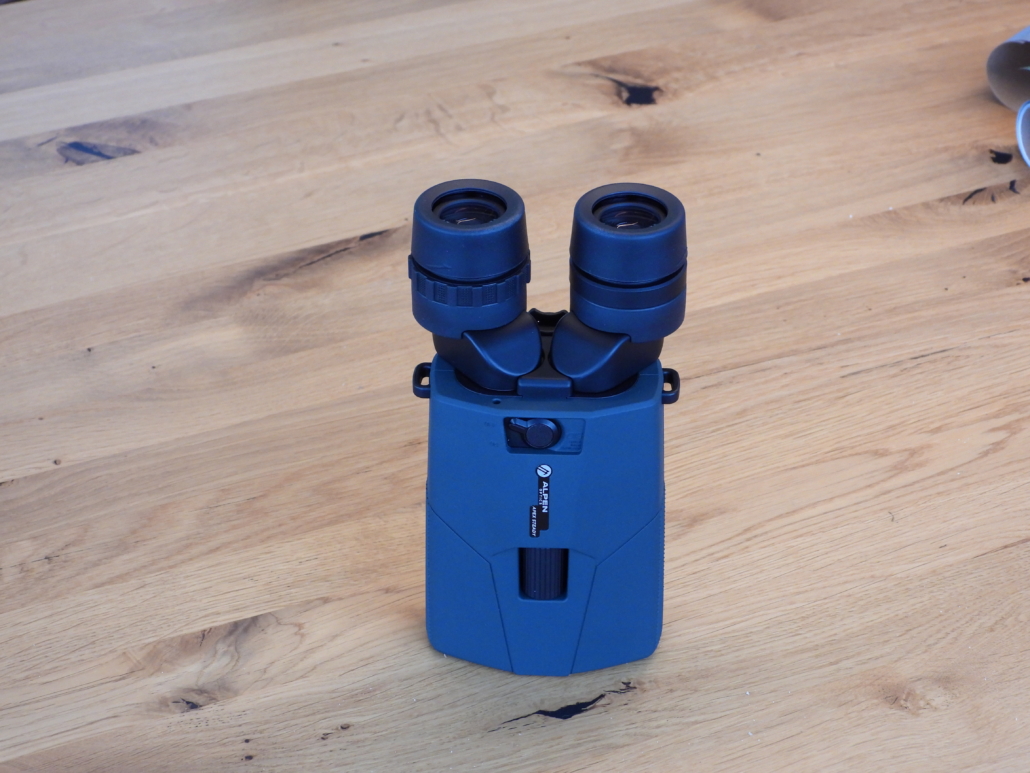
Alpen Optics 20×42 Apex Steady HD
Specifications:
Objective diameter (acc. to spec.): 42 mm
Free aperture (measured): 40 mm
Magnification (acc. to spec.): 20 x
Magnification (measured): 20.5 x
Exit pupil (measured) : 1.95 mm
Eye relief (measured): 18.5 mm
Usable eye relief (measured from rim of eyecup): 15 mm
IPD (measured): 54 – 74 mm
RFOV (acc. to spec. and measured ): 3.3 degrees = 58 m
AFOV (measured, rounded): 60.5 degrees
Minimum focus distance (acc. to spec.): 4 m
Minimum focus distance (measured): 3.5 m
Focus type: CF (direction of rotation from close to infinity: < counter-clockwise)
Degrees of rotation of focus wheel from minimum focus to infinity (measured): 350 degrees
Range of diopter adjustment (estimate): +/- 4 dpt
Excess travel of focus wheel beyond infinity position (estimate): > 8 dpt
Prism system: Schmidt-Pechan
Waterproof: splashproof
Weight ( acc. to spec.): 644 g
Weight (measured, with eyepiece and objective cover, strap and batteries): 784 g
Made in: Japan (?)
Remarks:
While Canon, Vixen and Fujinon appear to use their own technology (?) for image stabilization, it seems that most of the other brands, particularly Kite, SIG Sauer, Opticron, Bresser, Kenko etc. are all using the same Kamakura technology, or even have Kamakura build their full binos with some minor modifications, mostly exterior.
This is probably also true for Alpen Optics (nowadays a brand of the Bresser / JOC (Guangzhou Jinghua Precision Optics) group), although Alpen doesn’t admit that (neither the country nor the manufacturer are mentioned either on the binocular or in the sales literature; just the name “Alpen Optics GmbH” and its address in Germany is printed on the lower part of the binocular’s body).
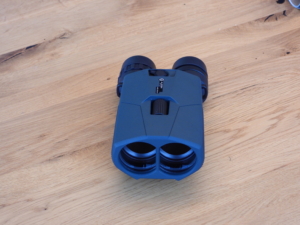
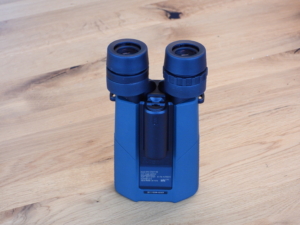
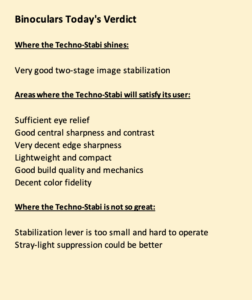
The Alpen 20×42 “Apex Steady” shares most of its specs with other 20×42 stabilized binos. It has been on the market for a year or so, and if you think about it, a lot speaks against such a 20×42: tiny exit pupil; less than optimal ergonomics (the battery is placed where you usually have your thumbs when holding the bino); CA is acceptable on-axis but increases from about 50% of the FOV outwards from the optical axis (which is to be expected in such a small body with high magnification, despite “HD” optics); there are clearly visible spikes on bright point light sources; judging from reflections when observing close to bright light sources, stray-light suppression is not optimal; the focusser and the stabilization lever are small and hard to operate with gloves, etc. On the other hand, the optics of the Alpen, which are not superb, are quite okay, central sharpness is good, edge sharpness very acceptable; the weight is surprisingly low; mechanics including the focuser are fine; the build quality is good. AND: The stabilization works quite well. The standard stabilization mode – Alpen calls it “balance mode (floating mode)” – which is supposed to be suitable for observing moving objects – eliminates the tiny vibrations of my hands quite effectively, but not the larger movements of my arms. The “detail mode (still mode)” also eliminates movements with a larger amplitude. The image gets as stable as in other stabilized binoculars with a much lower magnification, such as the Canon 10×42 or 10×32. In this mode, the Alpen provides an impression that is closer to a mounted binocular than what many other high magnification stabilized binoculars provide. So despite the “flaws” mentioned above – esp. the tiny exit pupil – the detail recognition when observing with the Alpen under normal lighting conditions is surprisingly good. It might possibly show you at least as much as you would see with a mounted 25x spotting scope (esp. keeping in mind the “binocular summation” effect) – at a weight of less than 800 grams.
{{ to be updated }}
Ratings:


Leave a Reply
Want to join the discussion?Feel free to contribute!