
Voigtländer Vienna 8×42 “APO”
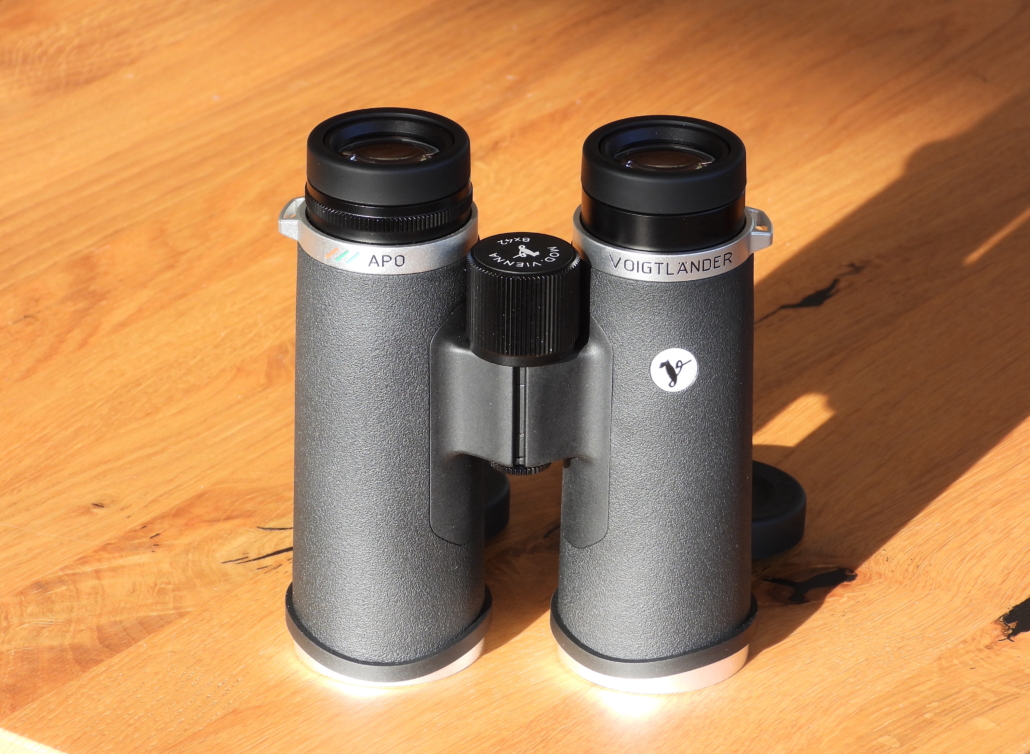
Specifications:
Objective diameter (acc. to spec. and measured): 42 mm
Magnification (acc. to spec. and measured): 8 x
Exit pupil (acc. to specs. and measured) : 5.25 mm
Eye relief (acc. to specs.): 20.4 mm
Usable eye relief (measured from rim of eyecup): 16.5 mm
IPD (acc. to specs.): 55 – 72 mm
IPD (measured): 56 – 74 mm
RFOV (acc. to spec.): 8.1 degrees = 142 m
RFOV (measured ): 8.0 degrees = 140 m
AFOV (acc. to specs.): 59 degrees
AFOV (measured, rounded): 58.5 degrees
Minimum focus distance (acc. to spec.): 2 m
Minimum focus distance (measured): 1.75 m
Focus type: CF (direction of rotation from close to infinity: < counter-clockwise)
Degrees of rotation of focus wheel from minimum focus to infinity (measured): 480 degrees
Range of diopter adjustment (estimate): +/- 4 dpt
Excess travel of focus wheel beyond infinity position (estimate): > 6 dpt
Prism system: Schmidt-Pechan
Waterproof: yes
Weight ( acc. to spec.): 770 g
Weight (measured, with eyepiece and objective cover and strap): 878 g
Made in: (Japan?)
Remarks:
Voigtländer: With origins in the 18th century in Vienna, where Johann Christoph Voigtländer started making mathematical and optical instruments (measuring instruments, opera glasses), Voigtländer entered the photography market in the mid 19th century with lenses and cameras (working with the mathematician J.M. Petzval) and increasingly moved operations from Vienna to Braunschweig. Throughout the 20th century, the company was famous for their high quality lenses and cameras (I remember my father having a compact Voigtländer camera in the 1960s). In 1956, Voigtländer became part of Zeiss Ikon, but lacking sales led to the closure of the Braunschweig facility in 1971. Today, the brand name and rights belong to RINGFOTO, a large German photo group, while Cosina in Japan designs and builds lenses and objectives under the Voigtländer brand. It may be allowed to speculate that the new binocular line “Vienna” is also manufactured by Cosina; neither on the binoculars nor in the sales literature is there any hint where the binoculars are made.
see also the two other “Vienna” models in this collection, https://binocular.ch/voigtlander-vienna-8×32-apo/ and https://binocular.ch/voigtlander-vienna-8×25-apo/.
Ratings:
Review:
Voigtländer isn’t hiding its light under a bushel. Proudly boasting about its long company history, but also prominently marking “APO” on the front of the right tube, which we find a bit bold (see below).
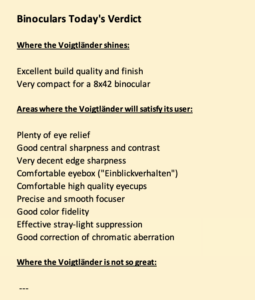
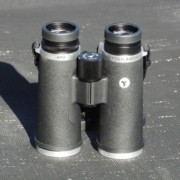
The Vienna exhibits an excellent build quality and finish. The haptics of the body armour are similar to the one of the GPO Passion; good grip when dry, slightly less so when wet. The binocular is just a tiny bit front-heavy, otherwise the ergonomics are fine. The weight is with 878g (fully equipped) very acceptable. The accessories include, beside the usual strap and covers, a hardshell case to be worn on the belt, opening on top.
The central hinge has the right stiffness. The comfortable high-quality eycups feature 4 positions (in, two intermediate click-stops, out), but do hold position even between stops. The focus wheel in metal operates slightly sticky, but very evenly and precisely, operation is counter-clockwise and relatively slow (480 degrees form close focus to infinity), there is plenty of excess travel beyond infinity. The diopter adjustment ring on the right tube works just fine (no lock, but sufficiently stiff), the “O” position is correctly set.
Inspecting the bino from the front and back end: there are not only some light structures around the exit pupil, but also false pupils (at 11 resp. 1 o’clock) relatively close to the EP; looking at the oculars from an angle, there is clear vignetting. The tubes appear well baffled and darkened (not 100% though). The quality of the coatings appears okay (Voigtländer claims 90% transmission).
Eyebox (“Einblickverhalten”): the Vienna eyecups fit my eye sockets very well, allowing me to comfortably view the entire field of view. Sufficient eye relief (16.5 mm usable) allows the use of spectacles.
Close focus is good (the spec says 2m, in our sample: 1.75 m,).
Image quality:
The FOV is with 8 degrees not huge, but okay. Central sharpness is good , edge sharpness is very decent , the sweet spot is large enough to allow for your eyes to wander a bit. On the tripod, the very edge appears a bit blurred. This is not a flatfield binocular, there is quite a bit of field curvature; on the other hand, with a relatively modest distortion, panning is very comfortable, there is no noticeably globe effect. The image is bright and exhibits good color fidelity with no obvious hue.
Stray-light: No spikes, but a few slight reflections when observing close to strong light sources, but overall very acceptable stray-light suppression.
Chromatic aberration: CA is well corrected at the center, but color fringes do increasingly appear as you move about 50% and more from the center of the field towards the edge. Again quite acceptable in our view.
Ringfoto GmbH in Fürth grants a full 10 year warranty for the “Vienna” binoculars.
The Vienna out in the fields:
Not as lightweight around the neck as e.g. the SFL 8×40, but the Vienna is with around 880g (fully equipped) somewhere in the middle for a 8×42 (the range of my 8x42s goes from 700 – 1030). But the Vienna is even more compact than the SFL; easy and quick to lift up before the eyes; the eyebox is well designed. The image is very “even”, meaning no “Absam rings” or similar areas of different sharpness as you move your eyes through the field of view, pleasant panning. My fear that the focuser would be to slow to easily follow birds proved unnecessary, with just 1/6th to 1/7th of a turn from 10 meters to infinity, it’s not an problem. Glare has been a non-issue so far; there is a bit of off-axis CA visible on the usual demanding contrast situations (bare branches before a bright sky), but not excessive for our eyes.


Leave a Reply
Want to join the discussion?Feel free to contribute!